An integrated solar heating system for private homes
NaturaTemp solar home heating is one system that heats your pool, jacuzzi, underfloor heating and hot-water tank. Solar water-heating panels collect the sun's heat, and a smart controller decides where it goes. A heat pump tops up automatically only when needed. We design and install these systems in private homes across Israel.
What you see in the app
Sample data- A site survey and a detailed quote before any work
- Designed and installed by our engineers
- 5-year warranty and support after installation
What we install
Solar water-heating panels made of glass vacuum tubes. This is solar water heating, not a power system: the panels heat water and keep working on cold days.
What the system heats
- Pool: swim more months a year
- Jacuzzi: heated by the same panels
- Water underfloor heating or fan coils: a warm house in winter
- Hot-water tank: hot water all year
What can solar collectors heat in a home?
A pool, a jacuzzi, space heating through underfloor pipes or fan coils, and the hot-water tank, all from one system. The controller shares out the heat by priorities we set together with you.
Pool
In summer and the shoulder seasons the controller sends heat to the pool by the priority order, so you swim more months a year. How many panels you need, swimming in winter and why a cover helps are on the pool page.
Jacuzzi
The jacuzzi is heated by the same panels, so its electric heater is needed less.
Water underfloor heating or fan coils
Water underfloor heating runs at a relatively low water temperature, which makes it a good match for solar heat and a heat pump. In winter the controller can send the heat from the panels to the house, by the priority order set for your home. The house can also be heated with fan coils.
Hot water for the home
The hot-water tank is heated by the same panels all year.
How one system heats the whole home
The panels collect the sun's heat, the controller decides where it goes, and a heat pump tops up what's missing.
The panels collect heat
Glass vacuum tubes absorb the sun's heat in every season, even when it's cold and overcast outside. Our engineers decide on site how many panels you need and where they go.
The controller decides where
The controller keeps checking temperatures and sends the heat where it's needed: to the hot-water tank, the house, the jacuzzi or the pool.
A heat pump tops up
At night and on cloudy days, when the sun isn't enough, the controller switches on the heat pump automatically. So it runs fewer hours: a smaller bill, and the heat pump may last longer.
Remote monitoring and control
From your phone or computer you follow temperatures and system status and control the system. Many processes run automatically, as far as the equipment allows.
Why combine solar underfloor heating with a pool?
A home needs heating mainly in winter, so a solar system designed for underfloor heating alone may be used less in the summer months. When the pool and the household hot water are added, the same system works more months a year: in winter for the house, in summer for the pool, and all year round for the hot water.
The combination can improve the economics of the investment, but the savings and the payback depend on the size of the system, the energy consumption and the conditions of the home. At NaturaTemp we focus on designing combined systems and check the economics for each home separately.
Building a home? Plan for both heating and cooling from the start
At the construction stage, the water and control infrastructure can be designed to suit a combined heating and cooling system. In winter the home is heated through underfloor heating or fan coils, with solar collectors and a heat pump. In summer, suitable fan coils can cool with a reversible heat pump or a chiller.
To allow cooling, pipe insulation, condensate drainage, circuit zoning and suitable controls have to be planned in advance.
NaturaTemp helps design the system and coordinate the required infrastructure, according to the needs of the home and the scope of the project.
Planning to build a new home? It's worth consulting us at the design stage, even if the pool, the jacuzzi or the heating system will only be installed later. Preparing the pipes, the space for the equipment and the control infrastructure early can save expensive work and changes after the build is finished.
How many panels does a home need?
It depends on what you heat: the pool's volume, the underfloor area, a jacuzzi and the number of people in the house. Our engineers calculate the exact number at the site survey.
If the only free spot is in shade most of the day, we'll tell you upfront that the system won't pay off: better to know before installation.
For example: in a 230 m² house with a pool, underfloor heating throughout and a hot-water tank we installed 8 panels, with a heat pump topping up the heat as needed. The number for your home comes from the calculation at the survey.
A standard solar water heater, PV panels or an integrated system: what's the difference?
The difference is in what each system does for your home.
A standard solar water heater (dud shemesh)
Heats only the tap and shower water.
Photovoltaic panels
Make electricity, not heat. To heat a pool or a house with them, you also need a heat pump or a heating element.
A NaturaTemp integrated system
Heats water for the whole home: pool, jacuzzi, underfloor heating and the hot-water tank, with one controller deciding where the heat goes.
Project: a private home in northern Israel with a pool, underfloor heating and a hot-water tank
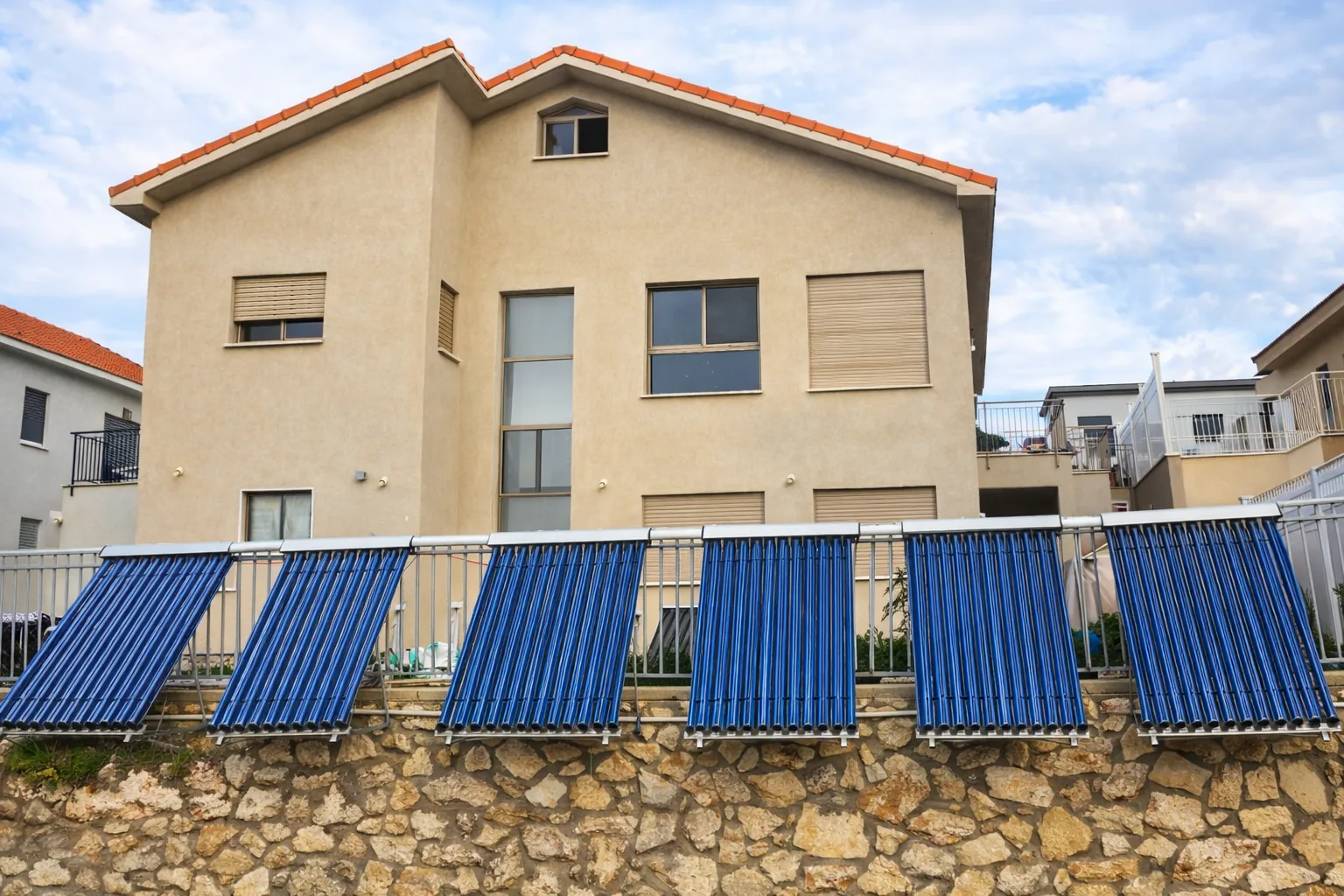
A private home in northern Israel, 2022: one system heats the pool, the underfloor heating throughout the house and the hot-water tank, and a heat pump tops up the heat when the sun is not enough. It is the house in the photo above.
Specification
- House: 230 m²
- Swimming pool
- Underfloor heating throughout the house
- Hot-water tank
- Panels: 8, along the garden fence
- Backup: a heat pump that tops up the heat as needed
- Control: smart controller that shares out the heat automatically
Result
- The pool is available for swimming more months a year; the heat pump covers what the sun does not
- One system instead of separate heaters for the pool, the house and the hot water
Solar home heating FAQ
What people ask us before installing an integrated system at home.
Can the system be installed in an existing home?
In most cases, yes. It connects to the hot-water tank, water underfloor heating and pool equipment; what exactly can be connected in your home, we check at the site survey. You need a spot that gets sun most of the day — a roof, a wall or the garden. Our engineers set the position, orientation and tilt on site.
Do I also need a heat pump?
In most homes, yes, as winter backup: at night and on cloudy days it tops up what the house and the hot-water tank need. The controller switches it on automatically, only when the sun isn't enough. Already have a heat pump? We'll check at the site survey whether it can be connected and what the controller can do with it.
What happens to my existing solar water heater?
The hot-water tank is heated by the same panels. Whether to keep or remove the collectors of your existing solar water heater is decided at the site survey, based on the roof and the tank.
Can it be installed alongside PV panels?
Yes. They're two separate systems: one heats water, the other makes electricity. Both can share one roof if the space is planned in advance.
How much does solar home heating cost?
We don't publish a fixed price because it depends on what you heat — pool, jacuzzi, underfloor, hot-water tank — on the number of panels, the roof and the pipe runs. After the site survey you get a detailed quote. What it costs to heat the pool with each method is in our guide: how much does it cost to heat a pool.
How long does installation take?
On-site work usually takes a few days, depending on what you heat. It follows a site survey and design, and for the first weeks after start-up we monitor the system remotely and fine-tune the settings to how you use it.
What about warranty and maintenance?
The system comes with a 5-year warranty. The panels have no moving parts, so maintenance is light: an annual check and dusting of the tubes. The app shows temperatures and system status, so anything unusual is easy to spot.